Djazagro 2026 has taken place in a moment that feels very different from just a couple of years ago. The exhibition has coincided with a clear reactivation of relations between Spain and Algeria both at institutional and business level.
After a period marked by diplomatic tensions and trade restrictions, the scenario is now gradually normalising. A recent visit by Spain’s Minister of Foreign Affairs to Algiers has reinforced this shift, sending a clear signal of renewed dialogue and willingness to strengthen bilateral ties. And this change is already being felt on the ground.
From collapse to recovery
Trade data helps explain why this edition of Djazagro has been particularly relevant.
According to the Observatori amec, Spanish exports of food technology to Algeria experienced a sharp decline between 2020 and 2023, dropping from €15.5 million to just €0.36 million. A contraction of almost 98% in only three years.
Since then, the trend has reversed. In 2025, exports have rebounded strongly to €11.8 million, confirming that the market is reopening and regaining activity.
That said, the recovery is still uneven.
Today, more than 70% of exports are concentrated in ingredients (mainly mixtures and preparations), while food processing machinery historically one of Spain’s strengths in this market remains at relatively low levels. This suggests that, beyond the rebound, there is still significant room to recover industrial positioning.
Algeria, back on the radar
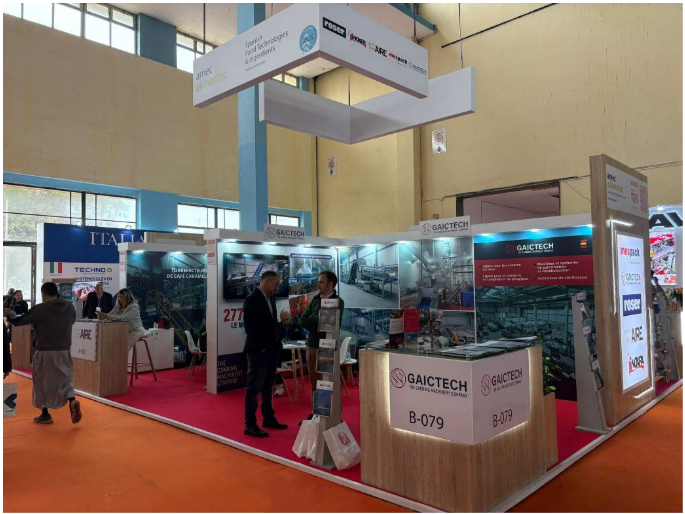
Against this backdrop, Djazagro has served as a key meeting point to reconnect with the Algerian market.
The companies present in the Spanish pavilion shared a common view: Algeria is once again a strategic market. Not only because of its size and demand potential, but also due to the natural proximity between both countries.
That proximity was noticeable throughout the fair in the quality of meetings, in the interest from local stakeholders and, above all, in a more constructive and open business environment.
Today, more than 70% of exports are concentrated in ingredients (mainly mixtures and preparations), while food processing machinery historically one of Spain’s strengths in this market remains at relatively low levels. This suggests that, beyond the rebound, there is still significant room to recover industrial positioning.
Spanish technology on display
GAITECH, with solutions aimed at improving efficiency and industrial processes
INOXPA, specialised in fluid handling and hygienic systems for food production
Mespack, presenting advanced packaging technologies with a focus on automation
ROSER CM, with equipment for food processing, particularly in prepared meals
TAVIL, focused on automation and end-of-line solutions
NEOCAFE ENGINEERING, bringing expertise in coffee processing technologies
Together, they reflected the breadth of Spanish capabilities and their potential role in supporting the development of Algeria’s agri-food industry
A recovery still to consolidate
The overall feeling at Djazagro was clearly positive. There is a sense that the relationship between both markets is back on track.
However, the data also invites some caution. The current recovery relies heavily on a limited number of product categories, and sectors such as machinery have not yet returned to previous levels.
This is precisely where opportunities lie.
For Spanish companies, Algeria is not a new market but it is one that is being rebuilt. And in that process, fairs like Djazagro play a key role: helping to restore connections, generate new business and gradually rebuild trust.
FOLLOW US
INTERNATIONAL OFFICE
One team to connect with the best Spanish companies